

Effects of Virtual Finger Thinness on Precise Target Repositioning in VR
概要
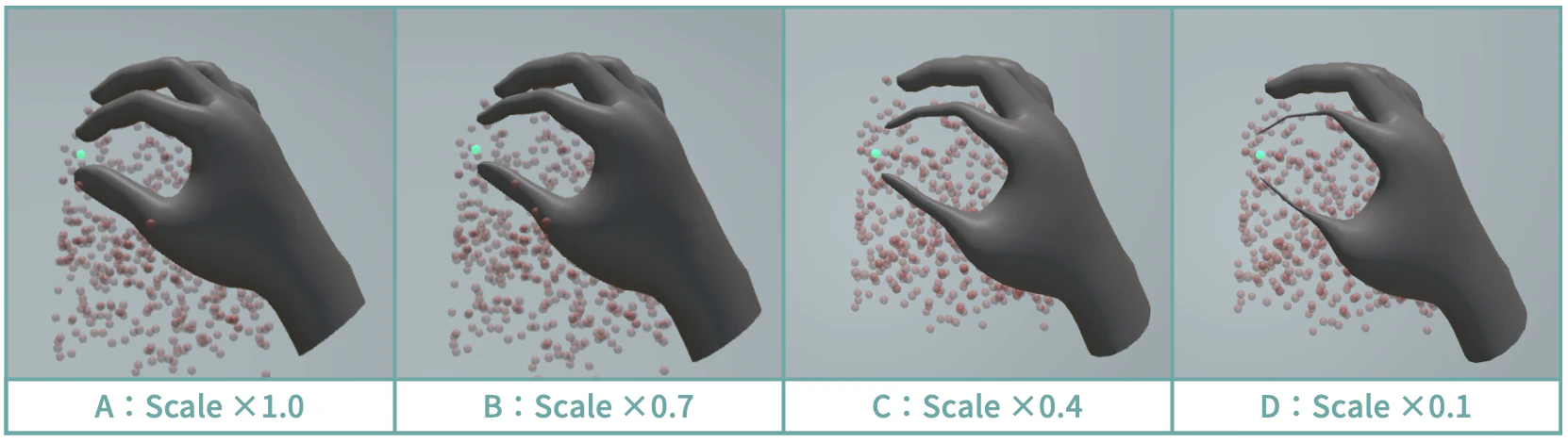
In VR, hand tracking—which uses cameras and image processing embedded in HMDs to recognize the user’s hands as direct input without a physical controller—has become widely adopted as an intuitive interaction paradigm; however, precise repositioning of densely packed small objects remains a significant challenge. Because fingers have a finite width, they can simultaneously occlude multiple adjacent targets in dense configurations, making it difficult to determine which object the user intends to manipulate. In this work, we focus on the thinness of virtual hand fingers. Displaying slimmer fingers is expected to reduce situations in which a single finger simultaneously overlaps multiple targets, thereby clarifying the intended object. To investigate how finger thinness affects precise target repositioning in VR, we conducted two experiments. Although fingers can technically be made arbitrarily thin, excessive thinning risks degrading the sense of body ownership and disrupting natural, intuitive interaction in VR. In Experiment 1, we varied finger thinness across seven levels to identify the range of finger thinness over which body ownership is maintained. In Experiment 2, using a pick-and-place task, we examined the effects of finger thinness on completion time, error rate, pinch distance, the number of erroneous grasps per trial, and subjective usability ratings. Our results show that finger thinness had a significant main effect on all objective measures: compared to the baseline (×1.00), the thinnest condition (×0.10) reduced completion time by 1.1 s (4.68 → 3.57 s), error rate by 12.2 percentage points (46.4% → 34.2%), and pinch distance by 1.2 mm (6.86 → 5.65 mm), and reduced the number of erroneous grasps per trial from 0.84 to 0.52. Subjective usability ratings were also affected by finger thinness, with comfort and accuracy peaking at an intermediate level (×0.40) rather than at the thinnest condition. This work quantitatively characterizes how finger thinness affects both body ownership and precise target repositioning, providing new design insights for virtual hands in VR.
デモビデオ
論文情報
Yonggi Cho and Keita Watanabe. 2026. Effects of Virtual Finger Thinness on Precise Target Repositioning in VR. In Proceedings of the 32nd ACM Symposium on Virtual Reality Software and Technology (VRST '26). Association for Computing Machinery, New York, NY, USA, 1–10. https://doi.org/10.1145/3822517.3848681