

BCI Control of Virtual Supernumerary Limbs: AnInvestigation of Imagery Separability and Sense ofEmbodiment in a Multitasking
概要
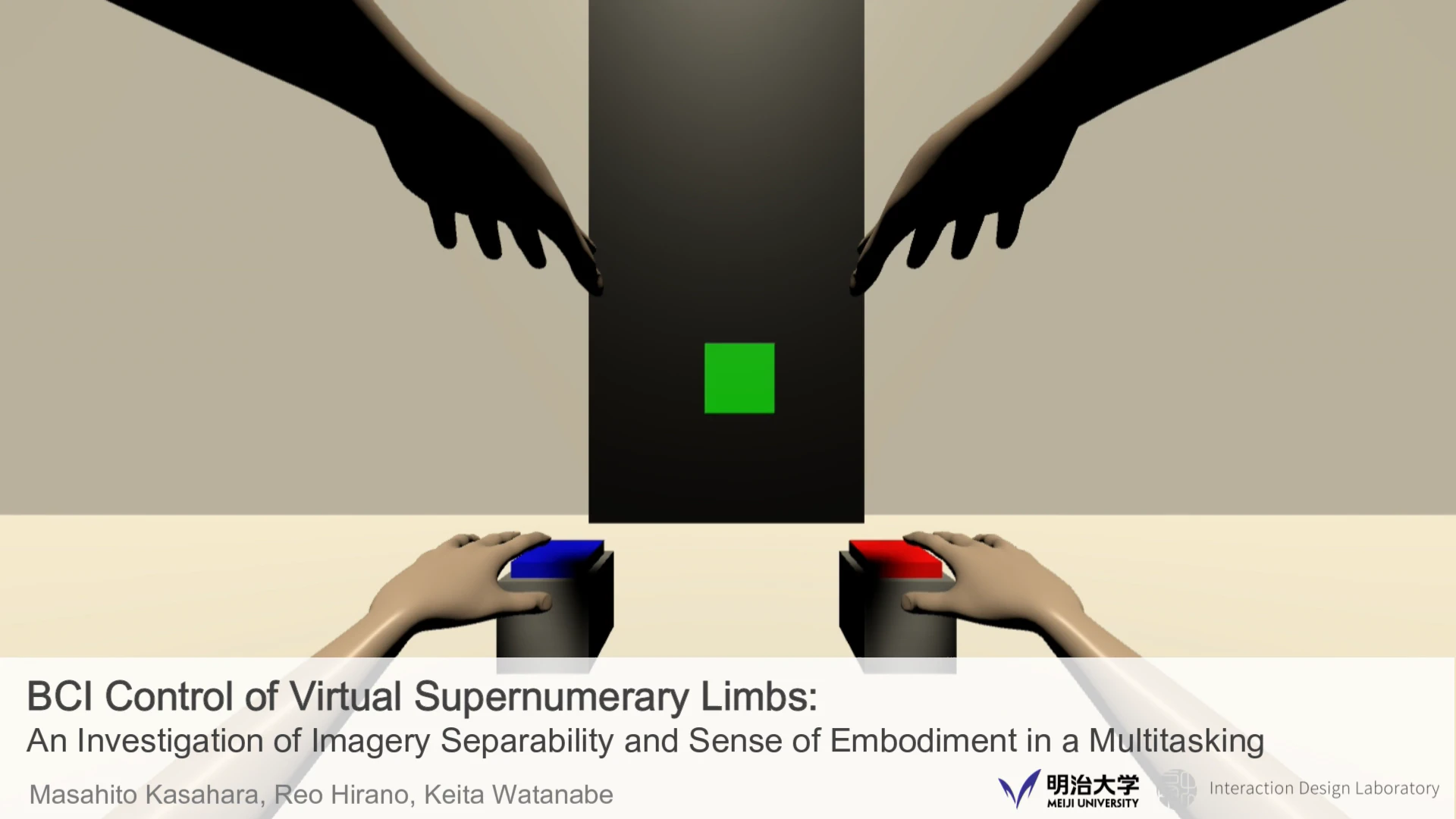
Supernumerary Robotic Limbs (SRL) augment motor function by operating independently from users’ innate limbs. Virtual reality (VR) environments implement SRL as Virtual Supernumerary Limbs (VSL), providing experimental spaces for investigating motor function augmentation and sense of embodiment. A critical aspect of SRL/VSL control is whether users can manipulate them as naturally as their own body parts. However, existing control methods face challenges including limb occupation and cognitive disconnection arising from mismatches between control and action sites. This study focuses on Motor Imagery Brain-Computer Interface (MI-BCI) control of VSL in VR environments, investigating frequency characteristics during imagery elicitation, online BCI performance, and sense of embodiment. We evaluated classification accuracy between motor imagery toward VSL and innate body, and investigated control accuracy and embodiment during VSL multitasking control. Results suggest that motor imagery toward VSL is separable from that toward innate arms, demonstrating particularly high classification accuracy in the α -band. Online BCI control results suggest the possibility of maintaining performance under multitasking environments, supporting the utility of BCI as a control channel for VSL. Furthermore, embodiment evaluation results indicate that Ownership and Response are maintained as stable individual characteristics, whereas Agency and Appearance evaluations suggest potential variation depending on task environments.
デモビデオ
論文情報
Masahito Kasahara, Reo Hirano, and Keita Watanabe. 2026. BCI Control of Virtual Supernumerary Limbs: AnInvestigation of Imagery Separability and Sense ofEmbodiment in a Multitasking. In Proceedings of the Augmented Humans International Conference 2026 (AHs '26). Association for Computing Machinery, New York, NY, USA, 538–548. https://doi.org/10.1145/3795011.3795015